
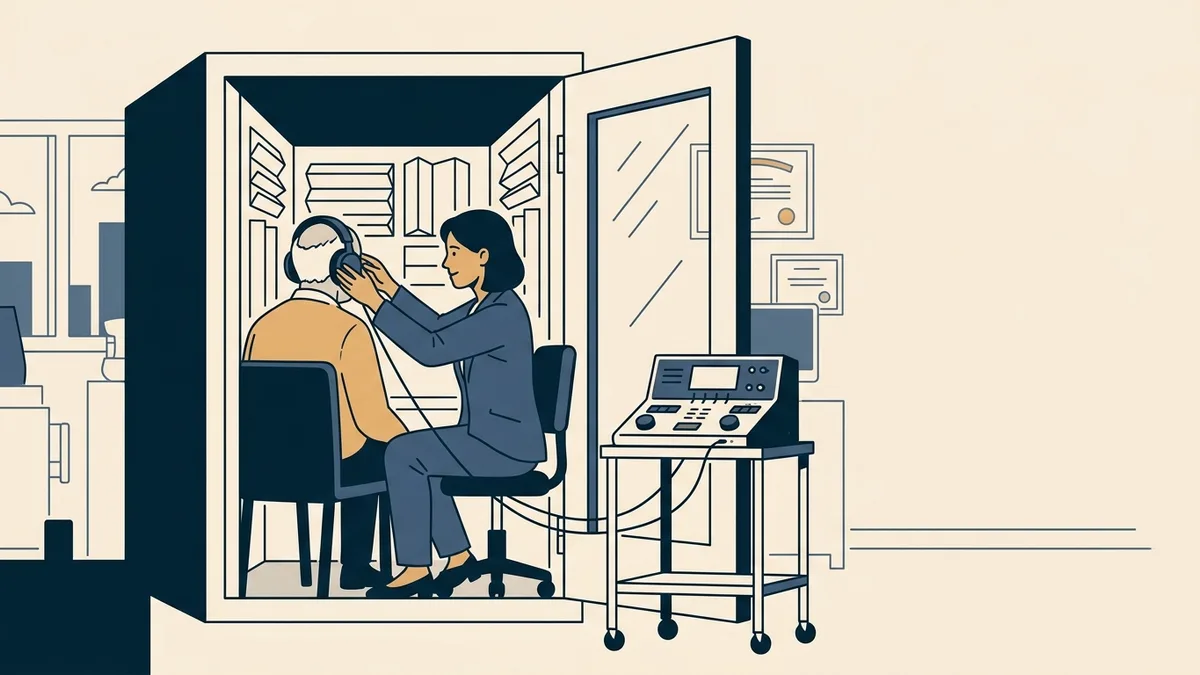
An audiologist licensed in one state usually gets a license in another by endorsement or a licensed-in-another-state pathway. Boards check your degree date against the doctoral requirement, a Praxis score or CCC-A or ABA certification, verifications of your licenses and a background check. Some, like Texas, add a jurisprudence exam, and dispensing may need a separate license.
Audiologists move for the same reasons SLPs do, but their endorsement files trip on different things. The degree date matters because of the doctoral requirement. The exam may be waived for ABA or CCC-A holders in one state and required in the next. And if you dispense hearing aids, the audiology license may not be the only credential you need. Here is how the boards we checked treat an audiologist who is already licensed somewhere else.
What does almost every audiology endorsement file include?
- The application and the board's fee. Amounts below are what each board's page or rule showed when we checked; confirm before paying.
- Proof of your degree, usually an official transcript. The date your degree was conferred can decide whether a master's degree is acceptable. See the AuD requirement and older audiology degrees.
- The national exam or a certification that stands in for it. Several boards accept ASHA's CCC-A or American Board of Audiology certification in place of a Praxis score.
- License verifications from the states that licensed you, sent by those boards. See license verifications.
- A background check, often fingerprints. See fingerprints and background checks.
- State extras: a jurisprudence exam, a copy of another state's law, or a separate dispensing credential.
How do eight states handle an audiologist licensed elsewhere?
Texas
TDLR's audiology application costs $150 and includes a two-year initial license. You need a doctoral degree in audiology or a related hearing science, or a master's in audiology conferred on or before December 31, 2007. The department may waive the internship and the Praxis for an applicant who holds a current CCC-A or current ABA certification. Every applicant also passes the Texas Jurisprudence Examination and submits fingerprints. Texas audiologists may dispense hearing aids under the audiology license, according to ASHA's Texas page. See Texas licensing.
California
California offers an audiologist who holds an active license in another state either a temporary or a full license, and a separate equivalent-qualifications pathway for current CCC-A or ABA holders. From January 1, 2008, the board requires a doctoral degree. The Praxis score must be at least 162 on test 5343 or 170 on test 5342, no more than five years old, and reported with code R8544. The board's fee schedule lists the application fee at $150 and the six-month temporary license for someone licensed in another state at $30. Dispensing hearing aids requires passing the state's written and practical dispensing exams and holding a dispensing license. See California licensing.
New York
New York's Path A for an audiologist licensed in another U.S. jurisdiction asks for an acceptable program with a practicum and at least 60 semester hours, at least two years of licensed experience within the six years before you apply, a passing Praxis score, certification from an acceptable certifying agency such as ASHA, and good standing in every jurisdiction where you are licensed. The audiology Praxis is test 5343, minimum 162, sent to code R7747. The State Education Department lists $294 for licensure and first registration. ASHA's New York page adds that audiologists who dispense hearing aids must be registered hearing aid dispensers. See New York licensing.
Illinois
Illinois requires a doctoral degree for an audiologist whose degree was conferred on or after January 1, 2008, and an official certification of licensure from the state that first licensed you and the state where you most recently practiced. A $45 Hearing Instrument Consumer Protection Act fee is built into every license and renewal fee, according to IDFPR's qualifications sheet. See Illinois licensing.
Pennsylvania
Pennsylvania's endorsement rule (49 Pa. Code § 45.25) asks for something most boards do not: a copy of the law or rule governing licensure in the jurisdiction that licensed you, including its enactment date, translated at your expense if it is not in English. Competency can be shown by at least two of the last five years in practice. The board may issue a provisional endorsement license for up to a year while you finish the requirements (§ 45.26), and a licensee of another state can also apply for a 90-day provisional license (§ 45.23). ASHA's Pennsylvania page says audiologists who dispense need a hearing aid dealer certificate but are not required to take the qualifying exam. See Pennsylvania licensing.
Florida
Florida's audiologist page offers a MOBILE endorsement pathway under section 456.0145 of the Florida Statutes for an applicant with an active, unencumbered license in another state, as well as the standard application. On the standard route the requirements include a doctoral degree with a major emphasis in audiology, 300 clock hours of supervised clinical practicum with at least 200 in audiology, and 11 months of professional employment experience, which a doctoral graduate can meet with a year of clinical work inside the doctoral program. The Praxis score must be within three years of the application. Florida wants verification of every license you hold or have ever held, in any state, territory or foreign country, mailed directly by the other licensing body; "a copy of your license is not considered verification." The fee is $280 or $180 depending on when in the two-year cycle the license is issued, and electronic fingerprinting is required. ASHA's Florida page says audiologists dispense under the audiology license. See Florida licensing.
Indiana
Indiana licenses audiologists from other states by reciprocity, with a nonrefundable $150 application fee, a criminal background check, a current license verification sent directly from the other board and verifications of any other licenses due by your first Indiana renewal. Every applicant passes a written jurisprudence exam on Indiana's statute, rules and health professions standards with a score of at least 75 percent, and the Professional Licensing Agency says "no applicant is exempt from taking the law examination." Licenses expire December 31 of odd-numbered years. See Indiana licensing.
Connecticut
Connecticut's Department of Public Health may license someone who holds a current license in another state and has practiced for at least four years, with verifications of every license held, current or expired. Applicants on that route are "not required to provide transcripts, verification of any training or be required to complete an examination." Connecticut audiologists can fit and sell hearing aids under the audiology license. See Connecticut licensing.
Can an audiologist use the ASLP Compact instead?
Sometimes, and far less often than people expect. As of October 2026, four states issue privileges: Louisiana and West Virginia since October 28, 2025, Ohio since February 9, 2026, and Tennessee since May 28, 2026. Your home state, where you live, must be one of the issuing states, and you must be eligible in your own right. The compact law requires a doctorate for audiologists who graduated on or after January 1, 2008. Each privilege costs the $50 Commission fee plus the state's fee, and you apply, attest and pay for it yourself in CompactConnect.
A privilege does not cover dispensing where a state requires a separate dispensing credential; the Commission's FAQ says you must obtain that credential. See the ASLP Compact for audiologists.
Where do audiology endorsement files stall?
- The degree date. A master's degree is acceptable in Texas only if conferred on or before December 31, 2007. A transcript that shows a later conferral date ends the conversation.
- An old Praxis score. California will not take a score more than five years old. Experienced audiologists licensed through ABA or the CCC-A may need the certification route instead.
- Forgetting the dispensing license. Licensed to practice audiology is not always licensed to sell hearing aids. See hearing aid dispensing licenses for audiologists.
- Paperwork from another state's legislature. Pennsylvania's requirement for a copy of the issuing state's law catches people who have never had to produce one.
- Every license, not just the current one. Connecticut wants verifications of all licenses, current or expired.
Who does the work if you hire us?
Our License by Endorsement service is $599 per state for an audiologist or SLP. If you dispense, the Hearing Aid Dispensing License Add-On is $349 per state, and Jurisprudence and State Law Exam Support is $249 per state for states like Texas; you take the exam yourself. We prepare the file, order verifications, coordinate fingerprints and answer deficiency letters, and you review and sign. Board, ETS and vendor fees are separate.
Common questions
- Do audiologists need a doctorate to get licensed in a new state?
- Usually, if the degree was conferred on or after January 1, 2008. Texas accepts a master's in audiology conferred on or before December 31, 2007, and California and Illinois use the same 2008 dividing line.
- Does ABA certification replace the Praxis for an audiology license?
- In some states. Texas may waive the Praxis and internship for current CCC-A or ABA holders, and California has an equivalent-qualifications pathway for them. Others still want the score.
- Can I dispense hearing aids with my new audiology license?
- It depends on the state. Texas and Florida allow dispensing under the audiology license, while California requires a separate dispensing license and New York requires registration as a hearing aid dispenser, according to ASHA's state pages.
- Is the ASLP Compact faster than endorsement for audiologists?
- Only if both your home state and the state you want are among the four issuing privileges as of October 2026: Louisiana, West Virginia, Ohio and Tennessee. Otherwise endorsement is the route.
Need Help with Your Application?
We handle the SLP and audiology licensing process end-to-end — eligibility screening, documents, board follow-ups, and tracking.