
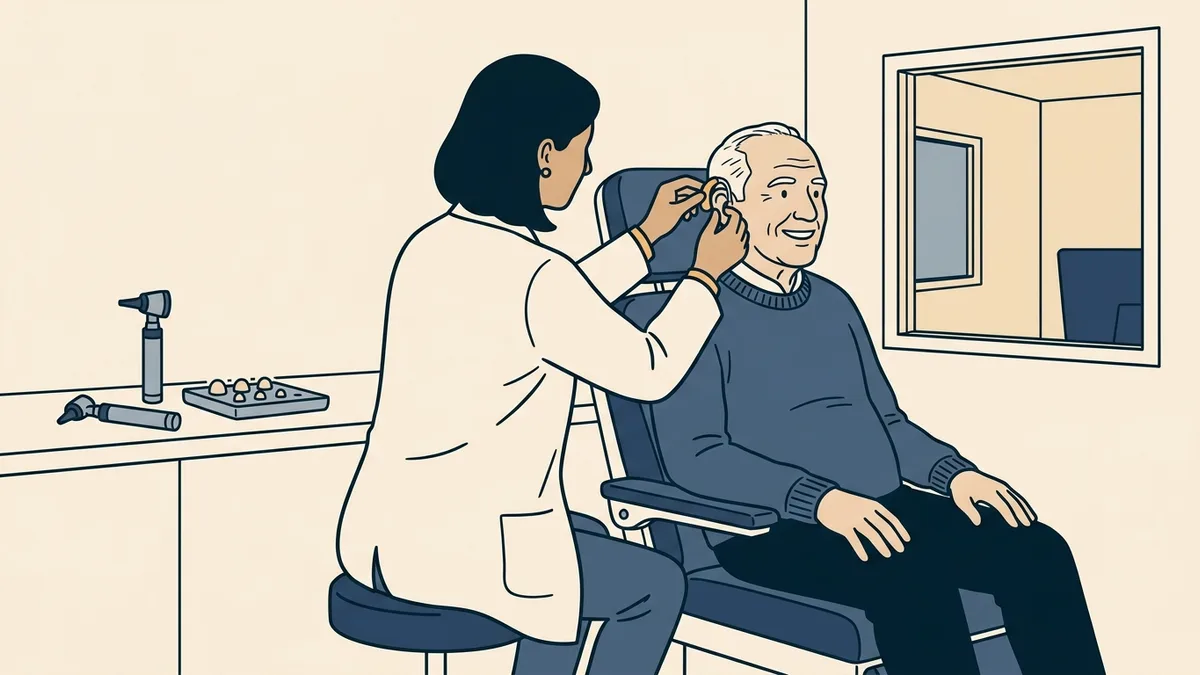
Audiologists use the same ASLP Compact privilege, fees and process as SLPs. Those who graduated on or after January 1, 2008 need a doctoral degree; earlier graduates can qualify with a master's. There is no postgraduate experience requirement. A privilege covers hearing aid dispensing only where the state does not require a separate dispensing credential.
The ASLP Compact covers audiologists and speech-language pathologists under one agreement, with one Commission and one data system. For an audiologist, a privilege works the same way it does for an SLP: you hold an active, unencumbered license in your home state, your home state must be issuing privileges, and you request a privilege in each other issuing state where you want to practice. As of October 2026, those states are Louisiana, West Virginia, Ohio and Tennessee.
The differences are in eligibility, and in what a privilege lets you do once you have it.
Which degree do you need?
Section 3.E of the model law sets the audiology education rule by graduation date:
- Graduated on or before December 31, 2007: a master's degree or doctorate in audiology, "or equivalent degree regardless of degree name," from an accredited program.
- Graduated on or after January 1, 2008: a doctoral degree in audiology, or equivalent degree regardless of name, from an accredited program.
- Graduated from a program outside the United States: the program and institution must be approved by that country's accrediting body, and an independent credentials review agency must verify the degree as comparable to a state board-approved program.
So a master's-level audiologist who graduated in 2006 qualifies on degree; one who graduated in 2009 with a master's does not meet the compact's degree rule. California applies a similar date line to its own audiology license: its board requires a doctoral degree or equivalent effective January 1, 2008, and a master's for those who completed before that date. See the AuD requirement and older audiology degrees.
What else does an audiologist need?
Section 3.E also requires a supervised clinical practicum "as required by the Commission," a passed national examination approved by the Commission, an active and unencumbered license, no felony conviction related to the practice of audiology, and a valid Social Security number or NPI. Section 4.A adds no encumbrance on any state license and no adverse action in the previous two years.
Unlike the SLP rule in Section 3.F, the audiology rule has no separate supervised postgraduate experience requirement. Audiologists also do not need ABA certification from the American Academy of Audiology or ASHA's CCC-A; the Commission's FAQ says neither is a requirement to participate.
The FBI fingerprint check through your home state applies to audiologists exactly as it does to SLPs. See the FBI background check behind the ASLP Compact.
Can you dispense hearing aids on a privilege?
Only in a state that does not require a separate credential for it. The Commission's FAQ: "If a state does not require a separate credential to dispense hearing aids, audiologists can do so through the compact privilege to practice. If a state requires a separate credential to dispense hearing aids, audiologists must obtain that credential to dispense hearing aids."
Check each remote state's practice act before you plan a dispensing practice there. The Commission's State Fee and Jurisprudence table links to each member state's practice act and rules. Outside the compact, rules can be stricter still. California, which is not a member, tells audiologists that "if you wish to dispense hearing aids, you must take and pass the California hearing aid dispensers written and practical licensing examinations." See hearing aid dispensing licenses for audiologists.
Do audiologists pay different fees?
No. The Commission's fee table has a single state fee per state and a single $50 Commission fee, with no audiology or SLP split. Among the issuing states: Ohio $25, West Virginia $25, Louisiana $50, Tennessee $150, plus $50 each. Two enacted states, Colorado and Vermont, list separate audiology and SLP boards in the table, but both are "not yet" issuing. See what a privilege costs.
How does a privilege help with Medicare?
Treat licensure and Medicare enrollment as separate steps. Medicare's Benefit Policy Manual defines a qualified audiologist as someone with a master's or doctoral degree in audiology who "is licensed as an audiologist by the State in which the individual furnishes such services." The Commission calls a privilege equivalent to a license, but ask your Medicare contractor how it records a privilege before you bill under one.
Two Medicare rules affect what an audiologist bills in any state. Since January 1, 2023, CMS lets beneficiaries see an audiologist without a physician or practitioner order for non-acute hearing assessments, billed with modifier AB, once every 12 months per beneficiary, according to the CY 2023 Physician Fee Schedule final rule fact sheet. And the Benefit Policy Manual says there is no provision for Medicare to pay audiologists for therapeutic services such as vestibular or auditory rehabilitation treatment. See Medicare enrollment for SLPs and audiologists.
Where does a privilege make sense for an audiologist?
- Diagnostic or teleaudiology work across issuing states. Practice occurs where the patient is located, and member states must recognize telehealth under a privilege (model law Section 5).
- A clinic near a state line between two issuing states, such as Ohio and West Virginia.
- Short-term coverage in another issuing state, where a $75 to $200 privilege beats a full application.
A privilege makes less sense when you need to dispense in a state that requires a separate license, when you are moving, or when the state is California, Texas, New York or another non-member.
How do we help audiologists?
For the compact, the ASLP Compact Readiness Review ($149 one time) checks your degree date against Section 3.E, your home license and FBI status, and each target state's dispensing rules. The Compact Privilege Concierge ($299 for the first privilege, $149 for each additional) is a guided session where you register, attest and pay yourself. For licenses, License by Endorsement is $599 per state, and the Hearing Aid Dispensing License Add-On is $349 per state. Board, exam and Commission fees are separate. See audiology license by endorsement and the ASLP Compact hub.
Common questions
- Can a master's-level audiologist use the ASLP Compact?
- Yes, if you graduated on or before December 31, 2007. Audiologists who graduated on or after January 1, 2008 need a doctoral degree in audiology or an equivalent degree.
- Can I dispense hearing aids on an ASLP Compact privilege?
- Only where the state does not require a separate dispensing credential. The Commission's FAQ says that where one is required, audiologists must obtain it.
- Do audiologists pay more than SLPs for a privilege?
- No. The Commission fee is $50 per privilege for both, and the state fee table does not separate audiology from speech-language pathology.
- Do audiologists need ABA certification or the CCC-A for the compact?
- No. The Commission's FAQ says neither ABA certification nor the CCC is a requirement to participate. A state may still require one for its own license.
Need Help with Your Application?
We handle the SLP and audiology licensing process end-to-end — eligibility screening, documents, board follow-ups, and tracking.