
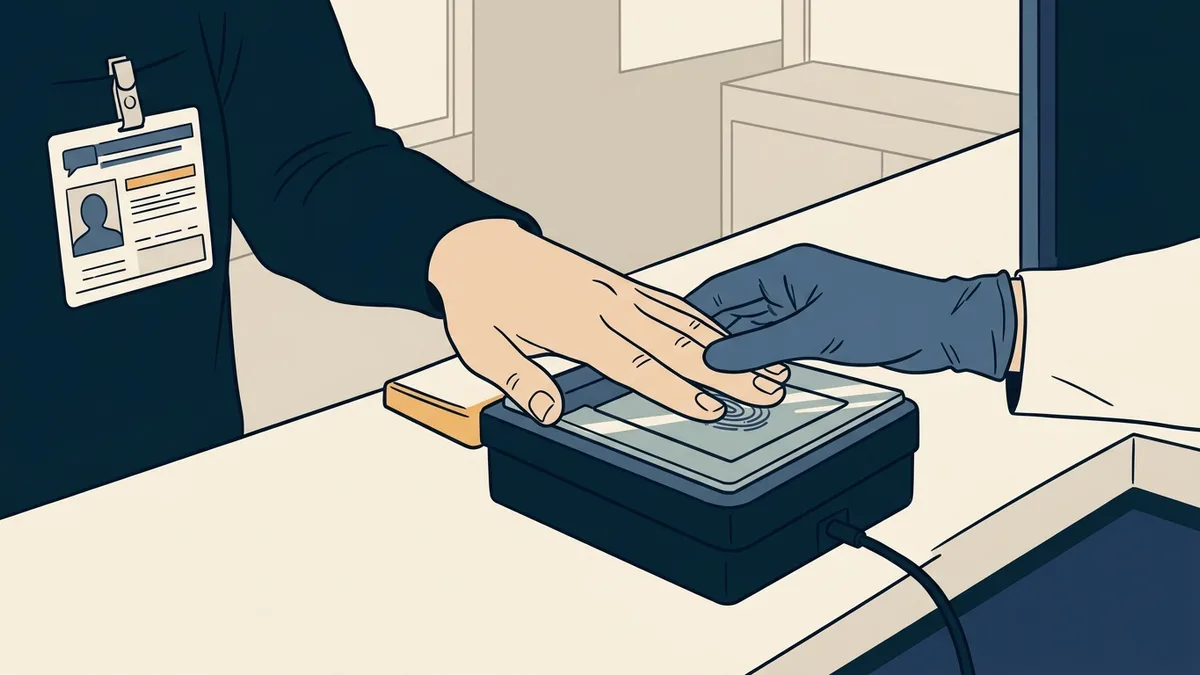
The ASLP Compact requires your home state to run a fingerprint-based FBI and state criminal background check before your first privilege. Results are reviewed only by your home state and are not shared with other states or the Commission. A state cannot issue privileges until it fully implements FBI checks, which is why most enacted states are not issuing.
Every ASLP Compact privilege rests on a criminal background check that your home state runs, using your fingerprints and the FBI's records. It is a statutory requirement, not a Commission preference, and until a state has it working, the state cannot issue privileges at all.
What does the compact require?
Section 3.B of the model law says a member state "must implement or utilize procedures for considering the criminal history records of applicants for initial privilege to practice," including "the submission of fingerprints or other biometric-based information by applicants for the purpose of obtaining an applicant's criminal history record information from the Federal Bureau of Investigation and the agency responsible for retaining that state's criminal records."
The Commission's Rule on Implementation of Criminal Background Check Requirement, amended June 30, 2025, spells out the applicant's side. A privilege seeker "shall submit to a criminal background check, including fingerprint-based state and federal background checks," by providing "a full set of fingerprints to the home state's designated agency" for checks through the FBI and the home state's criminal records agency. An applicant who does not submit, or whose check reveals disqualifying offenses as determined by the home state, "shall be deemed ineligible to obtain a compact privilege."
Why does it hold states back?
Because the state has to be able to receive FBI results before it can issue anything. The Commission's FAQ says a member state "cannot participate in authorizing issuance of compact privileges until such member state has completed the requirements to fully implement the FBI Criminal Background Check requirement." Full implementation means the state's licensing board is using FBI results "in making licensure decisions for all applicants seeking an initial license" as an audiologist or SLP.
The rule sets deadlines for getting there. A member state must submit its application for an FBI originating agency identifier (ORI) within sixty days of the compact's effective date in that state or of the rule, whichever comes first, and must fully implement checks within thirty days of approval. The Commission's Executive Committee can grant more time to a state that shows due diligence or a legal impossibility. Even after that, a state still has to onboard to CompactConnect. Our post on enacted is not issuing covers the full sequence.
Who sees the results?
Only your home state. The FAQ and the rule both say results "shall be reviewed solely by the member state in accordance with state law and shall not be shared, unless otherwise permitted under state law, with individuals, other member states, or the Commission." The model law adds that communications among states and the Commission about eligibility "shall not include any information received from the Federal Bureau of Investigation" (Section 3.B.2).
The remote state you are requesting does not see your rap sheet. It sees, through the data system, whether you have held other licenses and whether any license or privilege is encumbered or has had adverse action (Section 3.C). Your home state reports to the Commission anyone who is not eligible.
Do you need new fingerprints if you were licensed years ago?
Possibly. The FAQ describes the "initial privilege to practice" as steps "completed by the licensee's home state" that "include verifying the applicant's education, examination record, and criminal history record." The rule's purpose section refers to considering the criminal history of applicants licensed within the home state "prior to applying for the initial (i.e., very first time) privilege." If your home state never ran an FBI check on you, for example because you were licensed before it required fingerprints, expect your home board to ask for prints before you can request a first privilege. Each board sets its own process and vendor; ask your home board, not the Commission.
The check is tied to your initial privilege. The rule does not describe a new FBI check each time you renew a privilege, though your home state may have its own fingerprint rules for license renewal. Texas, for instance, tells some licensees they must provide new fingerprints before their license can be renewed, according to the Texas Department of Licensing and Regulation.
What if a state cannot get FBI access?
The rule has a narrow fallback. If a state shows the Executive Committee it applied for and was refused an ORI, it may issue and accept privileges for applicants who have not had an FBI check reviewed by a member state board. Those applicants must attest that they have no criminal history record, submit to a state-based check, and submit to an FBI fingerprint check within sixty days of being told the state can now run one. Failing to do that "may result in the removal of compact privileges to practice."
Does a background check problem end eligibility?
Not automatically. The compact excludes a felony "related to the practice of" audiology or speech-language pathology (Sections 3.E and 3.F), and the rule leaves the decision on disqualifying offenses to the home state "in accordance with Compact statutes and rules." If you have any history, talk to your home board before you register. CompactConnect's attestations include investigation and discipline questions, and they are legally binding.
How does this compare with a state license check?
State boards may fingerprint new license applicants anyway. Texas requires all new SLP applicants to submit fingerprints for a national criminal history record review. California requires fingerprinting for SLP and audiology licensure. The difference with the compact is that one check in your home state supports privileges in several remote states, instead of a separate set of prints for each state license. See fingerprints and background checks for SLP licenses.
Our ASLP Compact Readiness Review ($149 one time) includes confirming with your home board whether your FBI check is on file and what you need to do if it is not. We coordinate fingerprint logistics for state license applications as part of our License by Endorsement service ($599 per state). The ASLP Compact hub has the current issuing list.
Common questions
- Who runs the FBI background check for an ASLP Compact privilege?
- Your home state. The Commission's rule says you provide fingerprints to your home state's designated agency, and the results are reviewed only by that state.
- Will the remote state see my criminal history?
- No. The model law and the Commission's rule bar sharing FBI results with other member states or the Commission. The remote state sees encumbrances and adverse actions through the data system.
- Do I need fingerprints again for each privilege?
- The rule ties the check to your initial privilege. Your home state may still have its own fingerprint rules for renewing your license.
- Why are so few states issuing ASLP privileges?
- A state cannot issue until it fully implements FBI background checks and onboards to CompactConnect. As of October 2026, only Louisiana, West Virginia, Ohio and Tennessee have done both.
Need Help with Your Application?
We handle the SLP and audiology licensing process end-to-end — eligibility screening, documents, board follow-ups, and tracking.