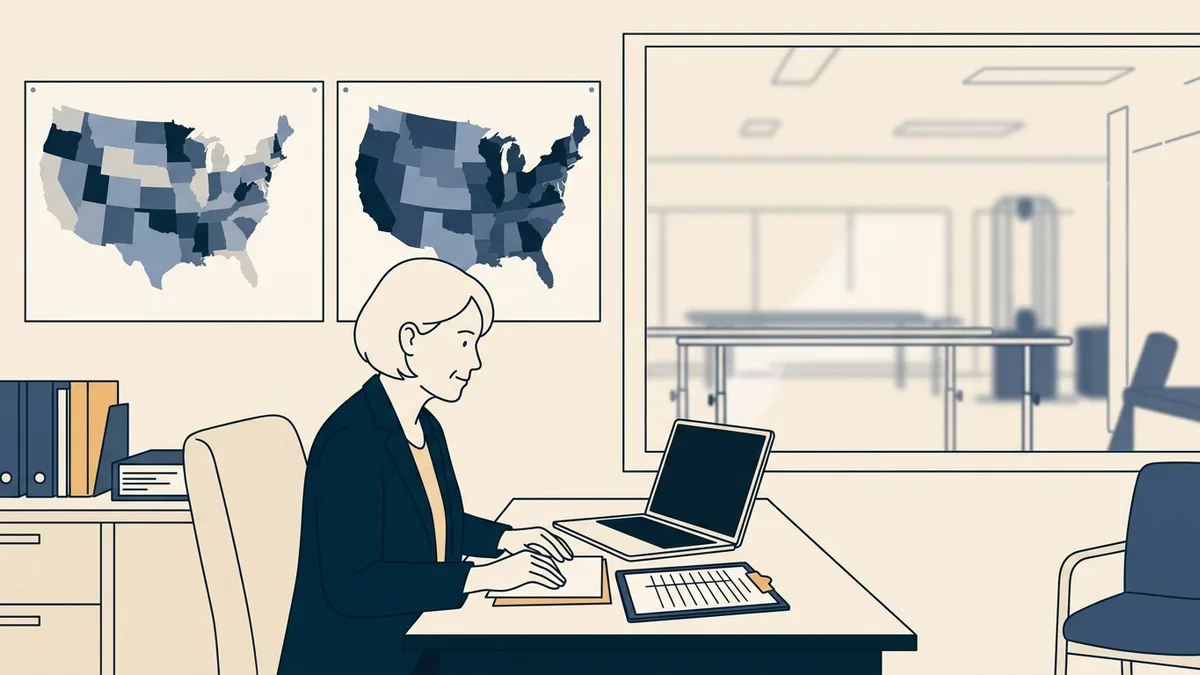
Compared side by side, both compacts use CompactConnect, a home-state license and a privilege per state that expires with the home license. The OT Compact covers assistants and has ten issuing states with a $75 fee; the ASLP Compact excludes SLPAs, has four issuing states and a $50 fee. Only Ohio, West Virginia and Tennessee issue under both.
Rehab departments, school contractors and staffing companies may employ both speech-language pathologists and occupational therapists, and both professions now have an interstate compact. Compared side by side, the two look alike at first glance. They share the same data system, CompactConnect, and the same basic design. Under the surface they differ in ways that change staffing plans: who is covered, where privileges are actually issued, what each costs, and how plainly each Commission speaks about third parties. Facts below are from aslpcompact.com and otcompact.gov as of October 2026.
What do the two compacts have in common?
- A home-state license. Both require an active, unencumbered license in the member state where you primarily live.
- A privilege per state. Both issue a privilege to practice in each remote member state, which each Commission describes as equivalent to a license.
- Same expiration logic. Compared directly, the rule matches: a privilege expires with the home license. The OT Commission's Before You Apply page says that "each time you renew your HSL, you will need to purchase a new OTC privilege"; the ASLP model law says a privilege is "valid until the expiration date of the home state license."
- An FBI background check through the home state. Both require it, and neither Commission runs it. Compared with the ASLP rule, the OT page puts it bluntly: "The OT Compact staff does not conduct or facilitate CBCs."
- CompactConnect. Both use it, and its privilege attestations are written in the first person.
- Enacted is not issuing. Both Commissions say enactment alone lets nobody practice.
Who is covered under each?
This is the largest difference. The OT Compact covers both occupational therapists and occupational therapy assistants. The ASLP Compact covers audiologists and speech-language pathologists only; its FAQ says "Assistants are not eligible for compact privileges." So unlike their OT colleagues on the assistant level, SLPAs need state licenses or registrations everywhere they work. Clinical fellows and anyone whose role requires supervision are also excluded from the ASLP Compact. See who the ASLP Compact does not cover.
Which states issue privileges under each?
The OT Compact is further along. The OT Commission's Before You Apply page lists ten states accepting applications, compared with four for ASLP:
- OT Compact (10): Minnesota, Ohio and West Virginia (January 12, 2026); Indiana (March 9, 2026); Virginia (March 20, 2026); Maryland (April 15, 2026); Tennessee (May 20, 2026); Wisconsin (May 29, 2026); Arkansas and Mississippi (October 5, 2026).
- ASLP Compact (4): Louisiana and West Virginia (October 28, 2025); Ohio (February 9, 2026); Tennessee (May 28, 2026).
Only Ohio, West Virginia and Tennessee issue under both. A therapy company in Ohio can use privileges for both professions in West Virginia and Tennessee; in Indiana or Virginia, versus the OT side, its SLPs still need state licenses. Louisiana is the reverse: issuing under the ASLP Compact, but listed "Not Yet" on the OT Commission's table.
Membership differs too. Compared with the ASLP map, where Michigan has only a pending bill, Michigan appears on the OT Commission's fee table as a member that is not yet accepting applications. Florida, Idaho and Nevada have enacted the ASLP Compact but do not appear on the OT table at all, unlike Michigan. California, Texas, New York and Illinois are not issuing under either.
How do the fees compare?
- Commission fee: $50 per ASLP privilege, versus $75 per OT privilege.
- State fees, ASLP: Ohio $25, West Virginia $25, Louisiana $50, Tennessee $150.
- State fees on the OT side, compared: Ohio $25, West Virginia $50, Tennessee $125 for an OT, Maryland $125.
Neither compact discounts multiple states. An Ohio-based SLP's Tennessee privilege totals $200; compared with that, an Ohio-based OT's Tennessee privilege totals $200 as well ($75 plus $125). See what an ASLP Compact privilege costs.
Where does jurisprudence apply?
Different states, different lists. For ASLP privileges the Commission's table flags Arizona, Indiana, Maryland, Missouri, Nevada, Tennessee and West Virginia. Versus that, the OT table shows jurisprudence information for Kentucky, Maryland, Missouri, North Carolina, North Dakota, Ohio and Wisconsin. Ohio is the notable split: no jurisprudence for an ASLP privilege, but, compared with that, a jurisprudence requirement on the OT side. See ASLP jurisprudence requirements.
Can an employer apply for staff under either?
No, under either, but the wording differs. The OT Commission states, unlike anything the ASLP Commission has published: "Employing agencies, third party affiliates, and/or other representatives may not legally complete the application on behalf of licensees. Licensees should create their own accounts, complete the application, and make the payment themselves."
The ASLP Commission has no sentence that direct, but its model law (Section 4.A), its Rule on Fees (Section 4.2: the fee "shall be paid by the licensee") and the first-person CompactConnect attestations reach the same result. A rehab director should run both professions the same way: each clinician registers, attests and pays personally, and the employer reimburses if it chooses. See can someone else apply for my ASLP privilege?
What should a mixed-discipline employer do?
- Map each clinician's home state against both issuing lists separately.
- Plan state licenses for every SLPA, every clinical fellow, and every SLP or audiologist outside the four ASLP issuing states.
- Budget per privilege, per state, per home renewal, under each compact's fee.
- Track home license dates. Under both compacts a lapsed home license switches off every privilege.
For the occupational therapy side, see our sister site's OT Compact guide at White Glove OT. For SLPs and audiologists, White Glove ASLP offers the ASLP Compact Readiness Review ($149 one time), the Compact Privilege Concierge ($299 for the first privilege, $149 for each additional, a guided session where the clinician applies, attests and pays), and state licenses from $599 per state. See the ASLP Compact hub.
Common questions
- Can SLPAs use a compact the way OTAs can?
- No. Unlike the OT Compact, which covers assistants, the ASLP Compact's FAQ says assistants are not eligible for privileges. SLPAs need a state license or registration in each state.
- Which states issue under both the OT and ASLP compacts?
- Compared as of October 2026, Ohio, West Virginia and Tennessee are issuing under both. Louisiana issues only under the ASLP Compact, and seven other states issue only on the OT side.
- Is the ASLP Compact fee the same as the OT Compact fee?
- No. Compared per privilege, the ASLP Commission fee is $50 versus $75 for the OT Compact, and each state sets its own fee on top under both.
- Can our company submit privileges for our therapists and SLPs?
- No, under either compact. Unlike the ASLP Commission, the OT Commission says so explicitly; the ASLP model law, fee rule and first-person attestations reach the same result.
Need Help with Your Application?
We handle the SLP and audiology licensing process end-to-end — eligibility screening, documents, board follow-ups, and tracking.