
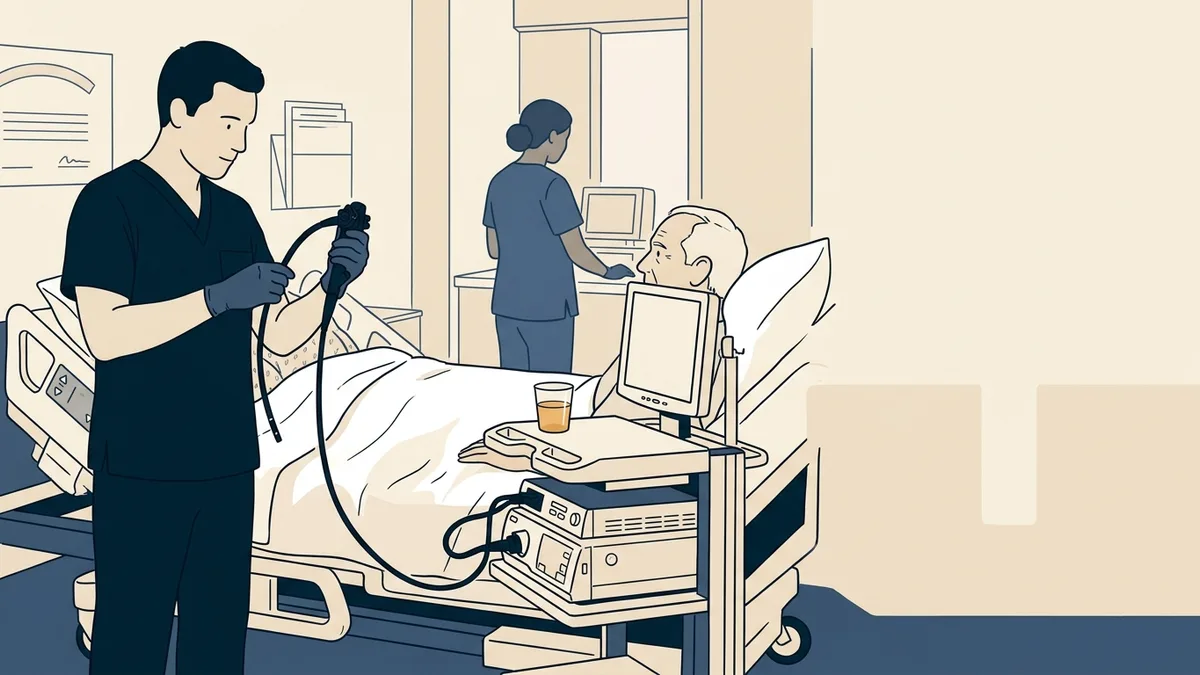
ASHA says SLPs need no special certification to perform FEES, but it lists 17 states with their own rules on instrumental assessment. California requires an otolaryngologist's written verification after 25 supervised procedures and a physician's order, New Jersey requires a physician present, and Tennessee requires a physician referral. A compact privilege follows the client's state rules.
Swallowing is part of speech-language pathology practice nationwide, but the instrumental procedures used to assess it are not regulated the same way everywhere. An SLP who has performed flexible endoscopic evaluations of swallowing (FEES) independently for years can move to a state that requires a physician's written sign-off, a physician's order for each study, or a physician physically present. None of that shows up on the license itself.
Does an SLP need a special credential to perform FEES?
Not from ASHA. ASHA's Practice Portal says SLPs "do not require special certification from ASHA or any other entity to perform instrumental assessments," and that SLPs with appropriate training and competence may perform FEES independently. How an individual develops and maintains competency "is determined by the clinician and their employer or facility." ASHA also says it does not require a physician to be present for an SLP to perform FEES, "however, there may be state-specific requirements and/or regulations."
ASHA's specialty certification in swallowing and swallowing disorders, offered through the American Board of Swallowing and Swallowing Disorders, is voluntary and not required to practice in this area.
Which states set their own rules?
ASHA's State Instrumental Assessment Requirements page, reviewed annually, lists 17 states with laws, regulations or policies on SLPs' use of instrumental assessment: Alabama, Arkansas, California, Colorado, Georgia, Illinois, Indiana, Maryland, Michigan, Missouri, New Jersey, New York, North Carolina, Pennsylvania, South Dakota, Tennessee and Virginia. Every other state, ASHA says, defines swallowing or voice as part of the practice of speech-language pathology.
Some of the 17 simply name instrumentation such as videofluoroscopy and nasendoscopy in the scope of practice. Others impose real conditions. The examples below are taken from the statutes, rules and board policies quoted on ASHA's compilation.
What do the strictest rules require?
California
California's practice act bars a licensed SLP from performing a flexible fiber optic transnasal endoscopic procedure without written verification from an otolaryngologist certified by the American Board of Otolaryngology that the SLP has performed at least 25 supervised procedures and is competent. The first 10 must be supervised by a physician who performs nasal endoscopy, and the next 15 by such a physician or by an SLP already verified as competent. The SLP keeps the verification on file for the board, passes the endoscope only on a physician's order, and works only in settings with emergency medical backup protocols, such as a licensed clinic, health facility, hospice or medical group practice. Verifications issued before January 1, 2023, are deemed to meet the requirement.
New Jersey
New Jersey's rule (N.J.A.C. 13:44C-7.2A) requires Basic Life Support certification, a 12-hour seminar in fiber optic endoscopy that qualifies for ASHA CE, observation of 10 FEES procedures and 25 procedures performed under supervision at a licensed facility that requires privileges for FEES. FEES may be done only in a state-licensed health care facility or the office of a physician trained in endoscopy, only on a physician's written request, and only with a physician trained in endoscopic examination present.
Tennessee
Tennessee's practice act requires written verification of competence from a board-certified otolaryngologist, based on training, a course of at least 15 hours on endoscopy and at least 25 procedures supervised by an otolaryngologist or an SLP with at least 50 procedures who has been approved in writing. The patient must be referred by an otolaryngologist or other qualified physician, the procedure must be non-operative, and emergency backup must be in place: a physician on the premises in a community setting such as an office, and general supervision with a physician readily available in a hospital or nursing home. The SLP sends the referring physician a report and a visual recording.
Indiana, Michigan and Virginia
- Indiana: an SLP performs procedures with rigid or flexible endoscopes "only under the authorization and general supervision" of a licensed physician (IC 25-35.6-1-9).
- Michigan: an SLP treats swallowing disorders only on patients referred by a physician, and limited diagnostic testing such as endoscopic videolaryngostroboscopy is done only in collaboration with or under the supervision of a physician (MCL 333.17607).
- Virginia: the board's policy is that a specially trained SLP may perform FEES under a physician order and the general supervision of a physician, with emergency response protocols in place.
Where the rule is about competence
North Carolina's board says whether an SLP may perform FEES depends on the individual's training, the facility and the hospital's risk management policy, and that SLPs who perform it "should be prepared to produce evidence of special preparation." South Dakota allows nonmedical endoscopy by a licensed SLP who has the training and competence, with emergency backup protocols in place (SDCL 36-37-6). Maryland's board has published guidelines on endoscopy, topical anesthesia and tracheal suctioning.
Does a compact privilege change the rules?
No. Under the compact's model law, practicing under a privilege subjects you to the licensing board, courts and laws of the state where the client is located. A FEES clinician from Ohio working in Tennessee on a privilege meets Tennessee's endoscopy conditions, not Ohio's. See the ASLP Compact, explained.
What should you gather before moving?
- A procedure log showing how many FEES you have performed and under whose supervision, especially your first 25.
- Any written competency verification from a physician or otolaryngologist.
- Certificates for endoscopy courses and current Basic Life Support.
- Your facility's privileging letter for FEES, which the new facility will want for its own process.
The state rule is the floor. The hospital or clinic decides who gets FEES privileges, and that process runs on its own timeline; our sister site explains credentialing, privileging and enrollment. Occupational therapists who work in feeding and swallowing face their own state limits, covered in swallowing and dysphagia credentials for OTs.
How can we help a dysphagia specialist license in a new state?
Our License by Endorsement service is $599 per state. Along with the license application itself, we point you to the state's instrumental assessment rules so you know before your start date whether you need a physician verification, orders or on-site supervision. Facility privileging is the employer's process, and you sign every application. See each state's requirements in the state license index.
Common questions
- Do I need a certification to perform FEES as an SLP?
- Not from ASHA, which says SLPs need no special certification for instrumental assessments if they have the training and competence. Some states add conditions, and facilities grant their own privileges.
- Which states regulate FEES by SLPs?
- ASHA lists 17 states with laws, regulations or policies on instrumental assessment, including California, New Jersey, Tennessee, Indiana, Michigan and Virginia. The conditions range from scope language to physician presence.
- Does California require a physician for FEES?
- California requires written verification from a board-certified otolaryngologist after at least 25 supervised procedures, a physician's order for each procedure, and a setting with emergency medical backup protocols.
- Can I perform FEES in another state on a compact privilege?
- Only under that state's rules. The compact's model law subjects privilege holders to the laws of the state where the client is located.
Need Help with Your Application?
We handle the SLP and audiology licensing process end-to-end — eligibility screening, documents, board follow-ups, and tracking.